XIAMEN ACEY NEW ENERGY TECHNOLOGY CO., LTD.
Semi-Automatic Prismatic Battery Pack Assembly Line Solution
Nov 18, 2026Semi-Automatic Prismatic Battery Pack Assembly Line Solution
Solution Overview
ACEY provides a semi-automatic assembly solution for prismatic lithium battery packs. The solution covers the full workflow from cell incoming inspection to finished pack aging, including cell capacity grading, OCV & ACIR sorting, module stacking and compression, laser cleaning, laser welding, BMS testing, comprehensive testing and charge-discharge aging.
The equipment list is selected according to cell specifications and pack design, including series-parallel arrangement, busbar requirements and electrical test standards. Each machine is configured for the formats required by the project. We also provide fully automatic turnkey lines for larger production volumes as your business grows.
Highlights of the Solution
1. Full process coverage
One-stop equipment configuration from cell grading to final pack aging, no need for multi-supplier sourcing.
2. Modular semi-automatic design
Standalone machine layout, flexible to adjust process sequence, easy for production arrangement.
3. Multi-stage quality control
Standardized testing and inspection at key stations, effectively reducing defective rate and rework cost.
4. Stable and precise testing
Core testing components support high-precision configurations, with data traceability and stable test results.
5. Scalable production planning
Suitable for initial process validation and small-batch production. We also provide dedicated fully automatic turnkey solutions for future mass production expansion.
Assembly Process
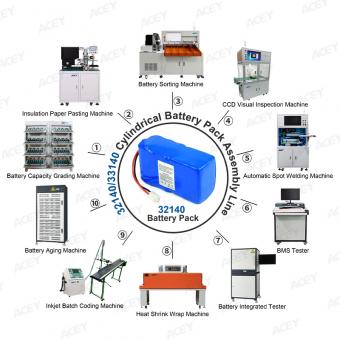
Cell capacity grading → OCV/ACIR sorting → Module stacking and compression → Terminal laser cleaning → Busbar laser welding → Manual pack assembly → Battery pack cpmprehensive testing → Pack charge & discharge aging
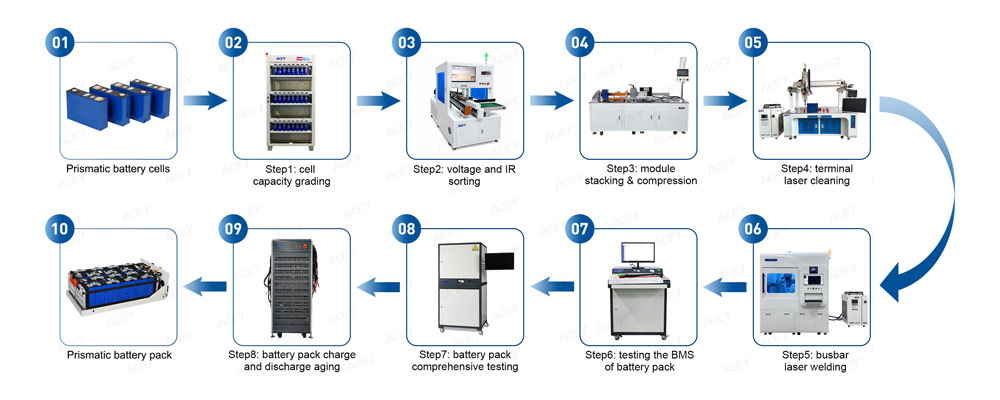
Equipment and Process Stations
| Station | Equipment | Process | Selection Criteria |
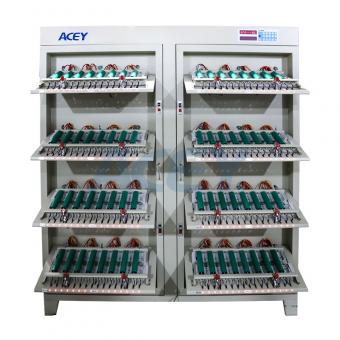
| Cell capacity grading | cell grading machine | Perform cyclic charge-discharge test to measure actual cell capacity, and match cells with consistent performance for pack assembly, ensuring long-term pack consistency. | Cell capacity, charge and discharge current, and required test channels |
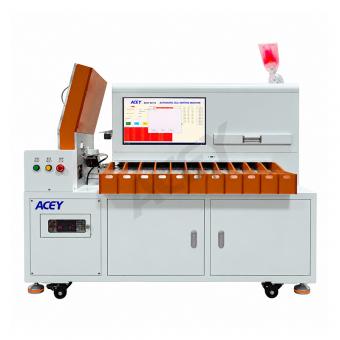
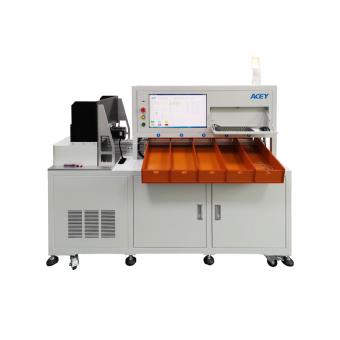
| Cell OCV and ACIR sorting | Battery sorting machine | Test the open circuit voltage and AC internal resistance of each cell, and automatically sort cells into groups to further ensure cell electrical performance consistency. | Cell dimensions, open-circuit voltage and AC internal resistance limits, and barcode requirements |
| Module stacking and compression | Battery Stacking and compression machine | Stack cells in sequence according to the pack design, apply fixed pressure to shape the module, and bind it with steel or plastic-steel straps to ensure consistent module size and structural stability. | Cell count, module dimensions, and compression requirements |
| Terminal preparation and busbar welding | Battery Laser welding machine | Check cell polarity and terminal positions before welding. Laser-clean the terminals where specified, position the busbars, and weld them to form the required series and parallel connections. | Terminal material and the surfaces to be cleaned before welding |
| BMS Testing & Installation | BMS testing machine | Test all protection functions of the BMS protection board first, then install it onto the pack and complete the wiring harness connection. | Number of cells in series (S), charge and discharge test currents, required protection functions, and balancing or communication tests if specified |
| Pack cpmprehensive testing | Battery pack comprehensive tester | Conduct full-item electrical performance testing on the finished pack, including open circuit voltage, AC internal resistance, charge-discharge performance and protection function verification. | Pack voltage, charge and discharge test currents, and acceptance criteria |
| Pack aging | Battery aging machine | Perform programmed charge-discharge cycle test on the finished pack, verify actual capacity and operational stability, and screen out early failure products. | Aging program, test duration, and number of packs tested in parallel |
Explore ACEY prismatic battery pack assembly equipment→
Key Configuration Choices
*Module Stacking and Compression
Send us your module drawing and specified compression force. We’ll check the cell count, finished module length, and how the stack is secured after pressing. If you plan to build several module sizes on one line, we’ll check whether they can use the same fixture and what needs to change during setup.
*Busbar Laser Welding
Share your cell terminal and busbar drawings, including the busbar material, thickness, and weld locations. We’ll use those details to select a laser welder and check that the fixture holds the busbar in place while leaving every weld point accessible.
*Pack Testing and Aging
Tell us your pack voltage, required charge and discharge test currents, and which checks each finished pack must pass. If you need charge–discharge aging, also tell us how long each pack stays on test and how many packs need aging per shift. That tells us how many parallel test channels to configure.
Applications
Request a Line Configuration and Quote
Share your cell datasheets, module and pack drawings, series and parallel configuration, daily output target, shift schedule, factory layout, and required test items. If you already operate a line, include the stations you want to retain or upgrade.
ACEY has delivered 400+ projects across 50+ countries, including standalone equipment and customized production lines. We provide commissioning guidance, operator and maintenance training, 24/7 online technical support, a 12-month warranty, and lifetime technical support.
Contact ACEY for a Line Configuration and Quote
Frequently Asked Questions
1. What cell sizes does this semi-automatic line support?
ACEY can configure the semi-automatic line to assemble packs using aluminum-cased prismatic lithium-ion cells with nominal capacities from 50 to 314 Ah. Some machines can handle multiple cell sizes. For each project, we select the equipment and fixtures based on your cell dimensions and terminal layout, then confirm which cell sizes the proposed line can accommodate.
2. Can the equipment connect to our existing MES?
MES integration can be configured for compatible equipment. We review your manufacturing execution system (MES) interface, communication protocol, and data requirements to determine which stations can exchange data and which records can be linked to each pack.
3. Can we buy only the stations we need for our existing line?
Yes. ACEY supplies individual machines or groups of stations. Send us your current equipment list and the steps you want to add. We’ll check how the new equipment fits your existing fixtures, workpiece handling, and test process.
4. Can we build different pack models on the same line?
Yes, when the selected machines and fixtures suit each model. Send us the drawings for all planned pack models. We’ll identify which stations can share tooling and where a changeover requires different fixtures, welding programs, or test settings.
5. Can you review our cells and busbars before recommending a laser welder?
Yes. We use your cell terminal drawings, busbar material and thickness, and weld positions to recommend a welding machine and fixture. If you need a welding trial with your own parts, share the sample details and weld acceptance criteria so we can confirm the trial scope.
6. How much floor space and how many operators will the line need?
Both depend on the station layout, target output, and how cells, modules, and packs are moved between stations. Share your workshop layout and planned staffing. We’ll review equipment placement, space for staging and transfer, and the manual tasks each operator needs to cover.
Rm703, No.223, Qishan North Road, Huli District, Xiamen, Fujian, China
Email : allen@xmacey.com
Tel : +8618950009155
Whatsapp : +8618950009155