
XIAMEN ACEY NEW ENERGY TECHNOLOGY CO., LTD.

Categorías
Blog nuevo
Cómo ensamblar un paquete de baterías cilíndricas: Guía de procesos y equipos
August 28 , 2026Cómo ensamblar un paquete de baterías cilíndricas: Guía de proceso y equipo
Las baterías cilíndricas utilizadas en herramientas eléctricas, bicicletas eléctricas, drones, estaciones de energía portátiles y sistemas de almacenamiento de energía pueden diferir mucho en voltaje, capacidad y estructura, pero la mayoría de las líneas de producción siguen una secuencia de ensamblaje similar.
Los pasos principales incluyen la clasificación de la capacidad de la celda, la aplicación del papel aislante, la clasificación de OCV y resistencia interna, la disposición de la celda, la inspección de polaridad, la soldadura por puntos y las pruebas del BMS.yinstalación, pruebas de empaquetado, embalaje, codificación y envejecimiento por carga y descarga finalizadas.
Estos procesos pueden organizarse como estaciones de trabajo fuera de línea, una línea semiautomática o una línea de producción totalmente automatizada.
Proceso de ensamblaje del paquete de baterías cilíndricas
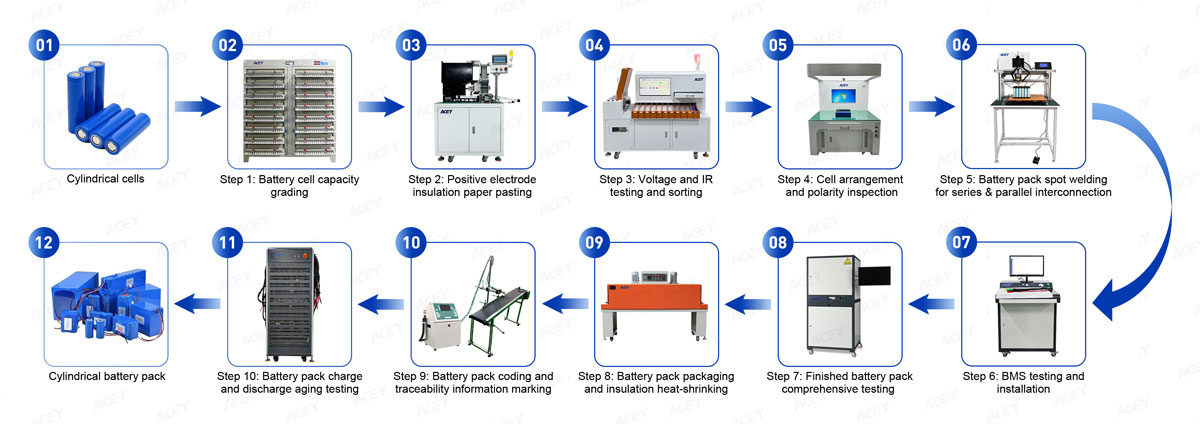
Clasificación de la capacidad de las celdas → Colocación del papel aislante → Clasificación OCV y ACIR → Disposición de las celdas → Inspección de polaridad → Soldadura por puntos → Pruebas e instalación del BMS → Pruebas del paquete de baterías → Empaquetado y codificación → Envejecimiento de carga/descarga
Los primeros pasos se centran en la uniformidad de las celdas y su correcta disposición. La soldadura y el ensamblaje del BMS establecen la conexión eléctrica del paquete, mientras que las pruebas y el envejecimiento del paquete terminado se utilizan para verificar la batería ensamblada antes del envío.
Componentes principales de un paquete de baterías cilíndricas
Un paquete de baterías cilíndricas se compone principalmente de:
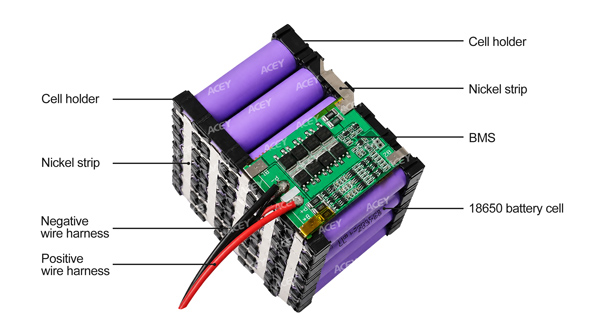
La conexión en serie determina la tensión del paquete, mientras que la conexión en paralelo aumenta la capacidad y la capacidad de corriente.
Tamaños comunes de celdas cilíndricas y sus aplicaciones
Formatos de celda compatibles
14500 · 18650 · 21700 · 26650 · 32650 · 32700 · 32140 · 33140
No todas las máquinas utilizan las mismas herramientas. Es posible que sea necesario cambiar los soportes, los portacables y los mecanismos de alimentación cuando cambie el diámetro, la altura o la estructura del paquete de celdas.
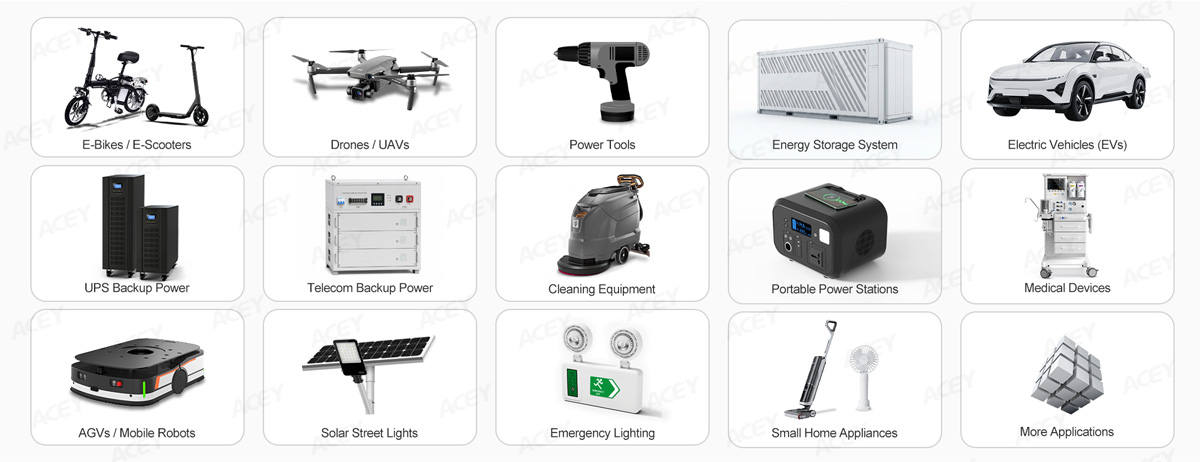
Aplicaciones típicas
¿Qué equipo se utiliza para ensamblar un paquete de baterías cilíndricas?
Una configuración de producción completa puede incluir el siguiente equipo:
| Proceso | Objetivo | Equipo |
| Clasificación de capacidad | Medir y agrupar células por capacidad | Máquina clasificadora de celdas de batería |
| Aislamiento | Aplique papel aislante al terminal positivo. | Máquina para pegar papel aislante |
| Clasificación OCV y ACIR | Agrupar las celdas por voltaje y resistencia. | Máquina clasificadora de baterías |
| Inspección de polaridad | Controlar terminales positivo y negativo del paquete | Máquina de prueba de polaridad CCD |
| Conexión eléctrica | Soldar las tiras de conexión a las celdas | Máquina de soldadura por puntos con paquete de baterías |
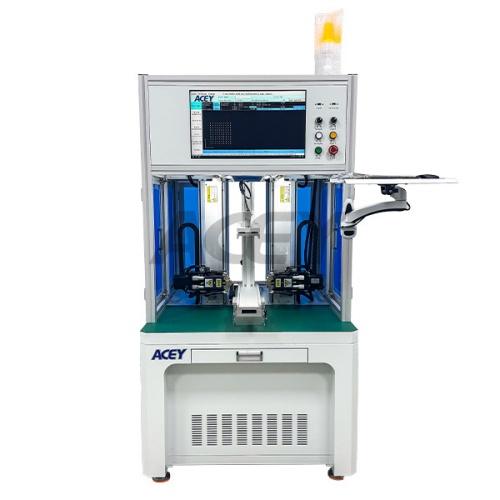
| Verificación del BMS | Prueba de las funciones de la placa de protección | Probador BMS |
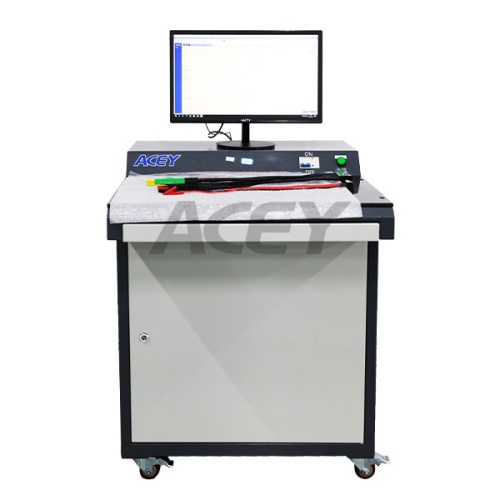
| Pruebas de empaque finalizado | Verificar el rendimiento del paquete ensamblado | Probador completo de baterías |
| Embalaje | Aplicar película termorretráctil | Máquina de termoencogimiento |
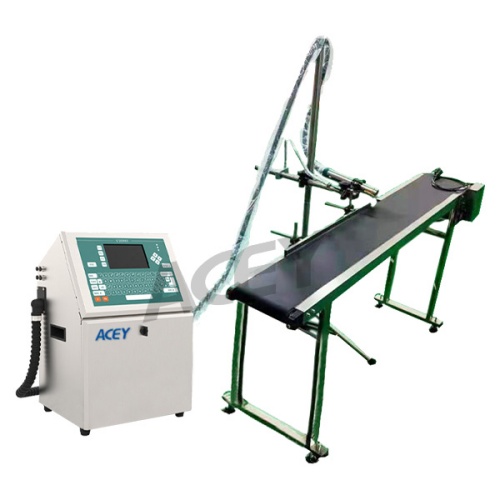
| Identificación | Imprimir información sobre lotes y productos | Máquina de codificación |
| Envejecimiento | Realizar ciclos de carga y descarga. | Probador de envejecimiento de paquetes de baterías |
Para la producción de prototipos o lotes pequeños, varias operaciones pueden seguir siendo manuales. Las líneas de producción masivas automatizan los procesos que más influyen en la consistencia y el rendimiento, especialmente la clasificación, la inspección de polaridad, la soldadura y las pruebas.
Paso 1: Clasificación de la capacidad de las celdas
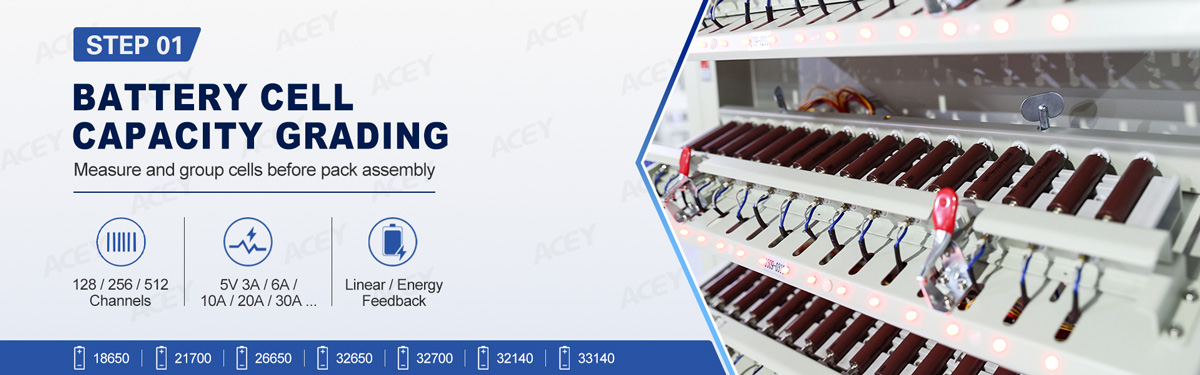
Antes del ensamblaje, las celdas se cargan y descargan para medir la capacidad útil y el rendimiento básico.
El objetivo es evitar que celdas con capacidades muy diferentes —debido al agotamiento o la pérdida de carga durante el almacenamiento o el transporte prolongados— se agrupen en el mismo paquete de baterías. Las celdas más débiles limitan el rendimiento útil de todo el conjunto, ya sea en serie o en paralelo.
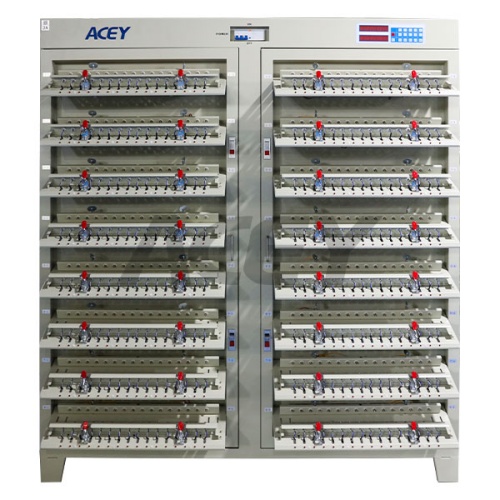
A litioion máquina clasificadora de células Realiza ciclos programados de carga y descarga a través de múltiples canales y registra los datos de cada celda.
Los sistemas de clasificación ACEY se pueden configurar para formatos cilíndricos comunes como:
18650 · 21700 · 26650 · 32650 · 32700 · 32140 · 33140
Las configuraciones disponibles incluyen:
Para el procesamiento de células a gran escala, la clasificación multicanal permite analizar cientos de células simultáneamente antes de que entren en la etapa de ensamblaje del paquete.
Equipo recomendado: Máquina clasificadora de celdas de batería
Paso 2: Aplicación del papel aislante
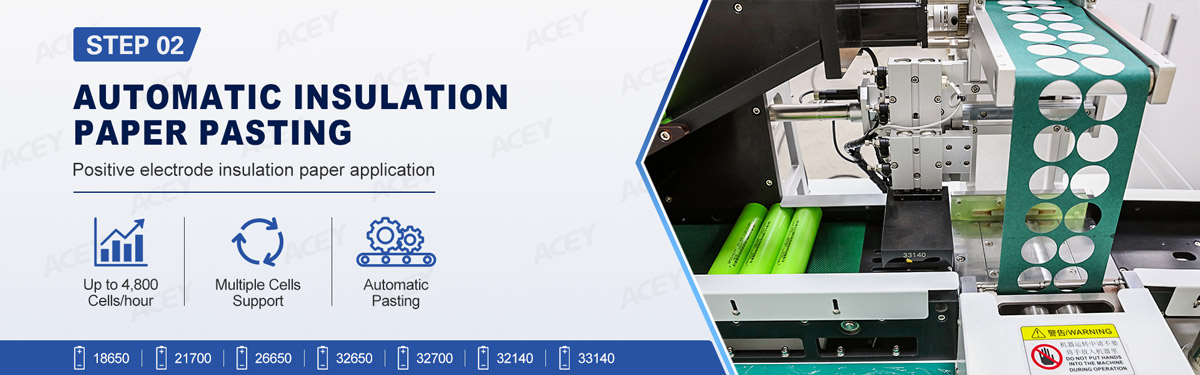
Tras la calibración de la capacitancia, se aplica papel aislante alrededor del terminal positivo.
Este aislamiento adicional ayuda a separar la zona del terminal positivo de la carcasa metálica de la celda (ánodo) durante el montaje.
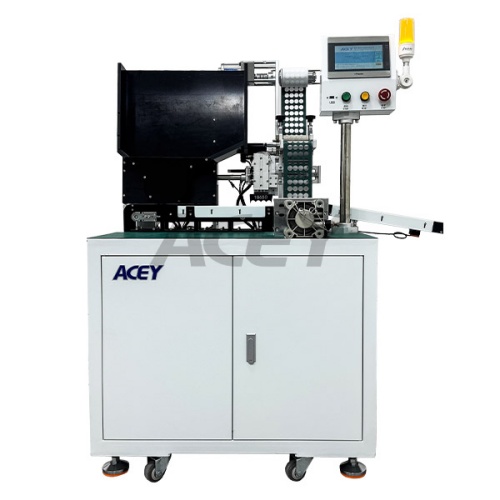
UnMáquina automática para pegar papel aislanteCorta y aplica el papel con un posicionamiento uniforme. Las máquinas ACEY pueden equiparse con herramientas intercambiables para diferentes celdas cilíndricas.
La velocidad de producción puede alcanzar hasta 4.800 células por hora, dependiendo de la configuración de la célula y de la máquina.
Los formatos comunes incluyen:
18650 · 21700 · 26650 · 32650 · 32700
Larger cylindrical cells such as 32140 and 33140 require suitable tooling and machine configuration.
Recommended Equipment: Battery Insulation Paper Sticking Machine
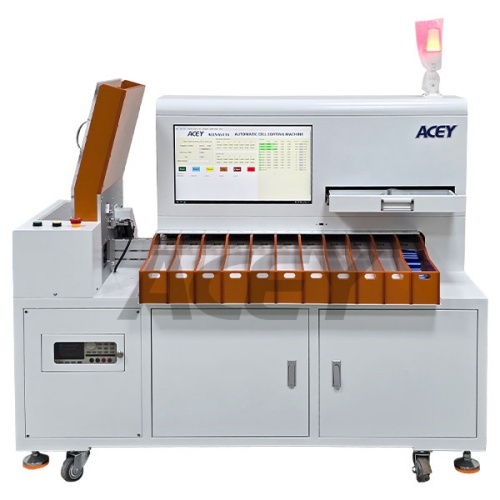
Step 3 — OCV and Internal Resistance Sorting
Capacity grading alone is not enough for final cell matching.
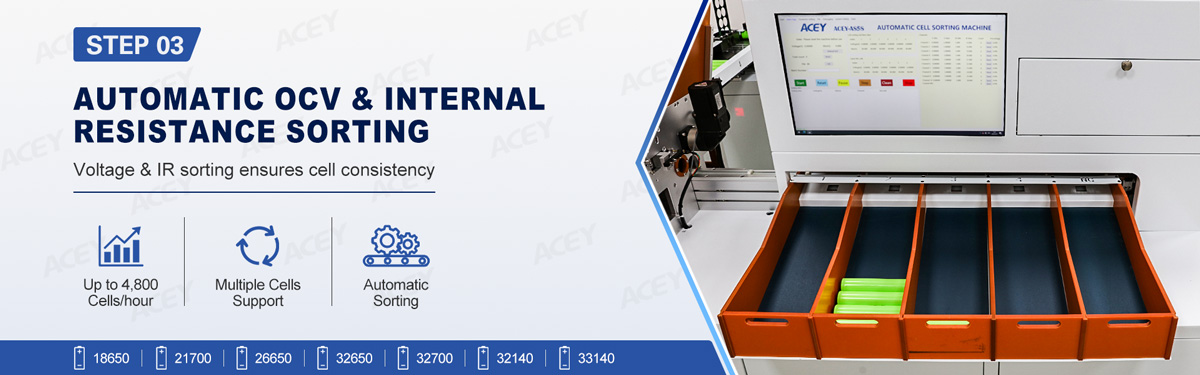
Before assembly, it is also necessary to measure theopen-circuit voltageandAC internal resistanceof the battery cells to ensure the consistency of the battery pack.
The measured values are compared with preset ranges, and the cells are automatically separated into different groups.
ACEY cylindrical battery sorting machines are available with standard 5-, 6-, 10-, or 11-channel configurations, with customized options also available. They can be integrated with branded testers such as the HIOKI BT3561 or other compatible instruments to measure open-circuit voltage (OCV) and AC internal resistance.
Barcode scanning can also be added when the production process requires cell-level traceability.
Cells with large differences in voltage or resistance may behave differently under charge and discharge. Sorting helps the manufacturer build packs from cells with closer electrical characteristics.
For production lines that combine insulation paper application and sorting, these processes can also be integrated to reduce repeated cell handling.
Recommended Equipment: Cylindrical Battery Sorting Machine
Step 4 — Cell Arrangement and Polarity Inspection
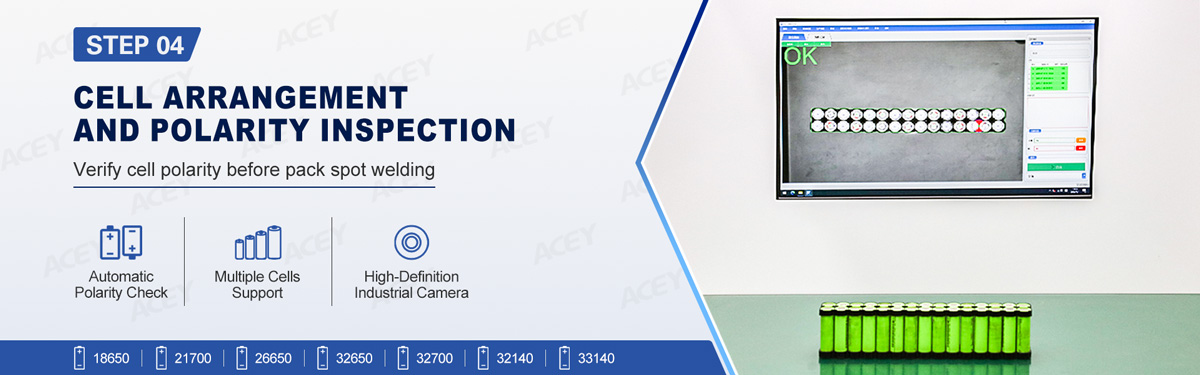
Sorted cells are placed into the required series-parallel arrangement using cell holders or dedicated fixtures.
Before welding, the positive and negative orientation of every cell should be checked.
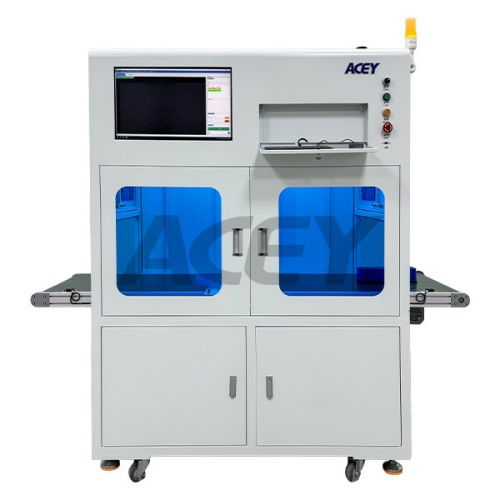
For small production runs, this may be done manually. On semi-automatic and automatic lines, a CCD polarity inspection system is more reliable because it checks the complete cell group against the preset pattern.
ACEY CCD inspection systems can be configured for cylindrical cells including:
18650 · 21700 · 26650 · 32650 · 32700 · 32140 · 33140
Any reversed or incorrectly positioned cell can be identified before the pack enters the welding station.
Recommended Equipment: CCD Tester
Step 5 — Battery Pack Spot Welding
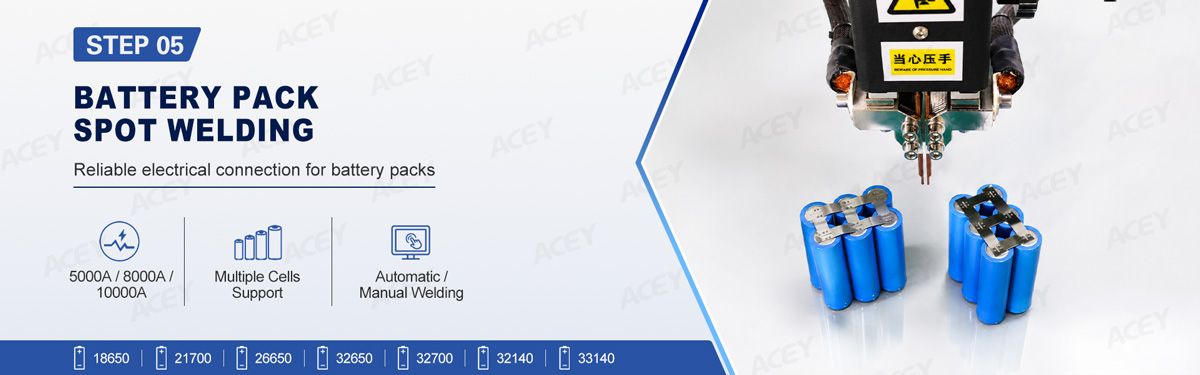
Spot welding is one of the most important operations in cylindrical battery pack assembly.
The cells are connected in series and parallel by welding nickel or nickel-plated connecting strips to the cell terminals.
The welding result is affected by more than welding current. The main process variables include:
ACEY provides 5000A, 8000A and 10000A DC inverter or transistor welding power supply configurations for cylindrical battery pack assembly.
Machine options include:
Automatic models can store welding programs for different battery pack designs and move between preset welding positions.
For production use, welding parameters should be validated with the actual cell and connecting strip. A parameter that works well on one battery pack should not automatically be copied to another design.
The inspection criteria may include weld appearance, connection strength and electrical resistance according to the manufacturer’s own process standard.
Recommended Equipment: Battery Pack Spot Welding Machine
Step 6 — BMS Testing and Installation
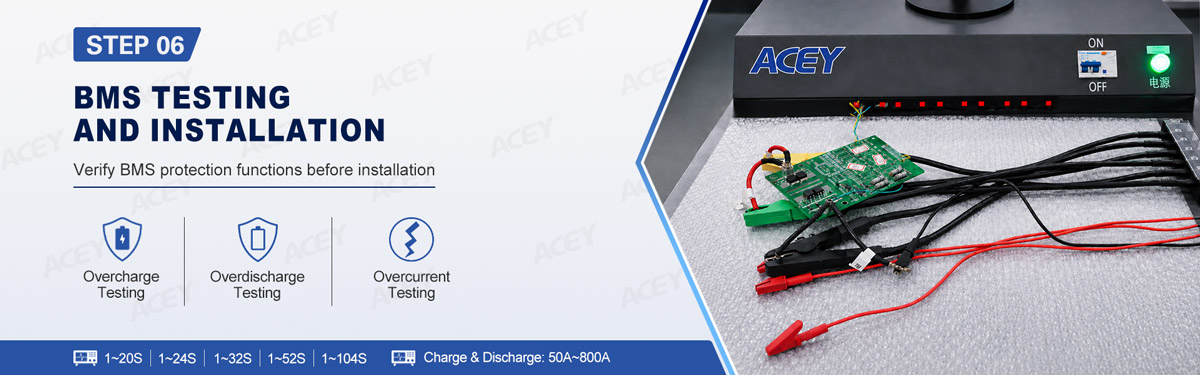
After the cell groups are electrically connected, the battery management system is installed according to the pack design.
Before installation or final integration, the BMS can be tested to verify its protection functions.
A BMS tester mainly check functions such as:
The required test range is determined by the BMS series count, voltage and current rating.
After BMS verification, assembly work includes:
This part of the process varies significantly from one battery pack to another. BMS specifications and electrical drawings are therefore important when configuring the assembly workstation or production line.
Recommended Equipment: BMS Tester
Step 7 — Finished Battery Pack Testing
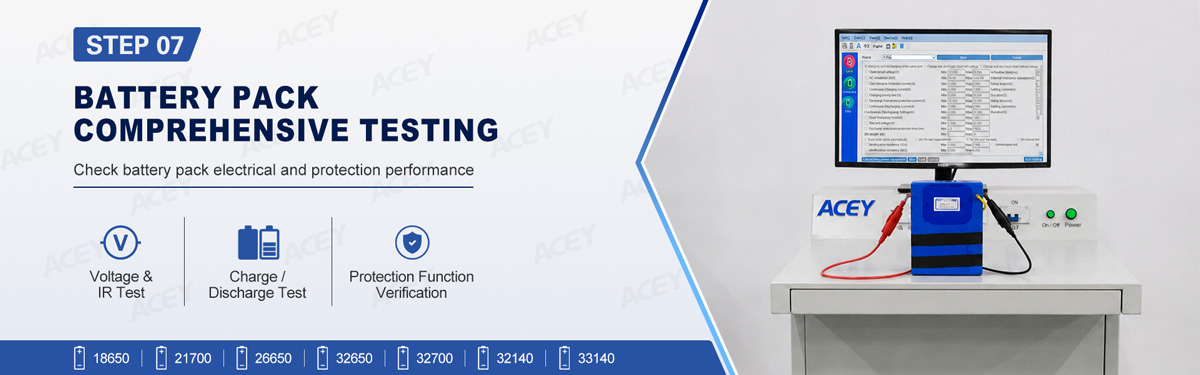
Once the BMS, wiring and electrical connections are complete, the battery pack is tested as a finished assembly.
This step checks components and connections introduced during battery pack assembly rather than the performance of an individual cell.
A battery comprehensive tester can be configured to test:
Upper and lower limits are set in the test program, allowing the equipment to identify qualified and unqualified packs.
Finished pack testing is particularly useful for detecting problems related to:
ACEY provides different voltage and current configurations for small and larger battery packs.
Recommended Equipment: Battery Comprehensive Tester
Step 8 — Battery Pack Packaging
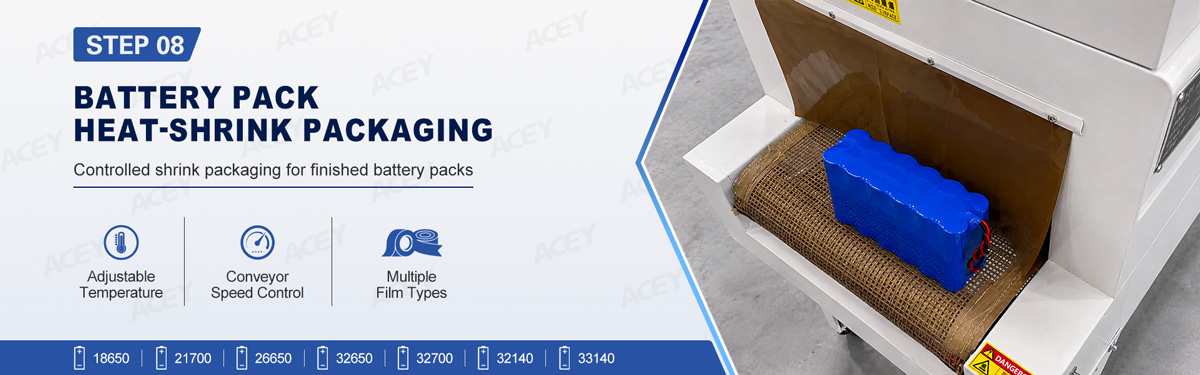
After electrical testing, the pack is prepared for final packaging.
The packaging method may include:
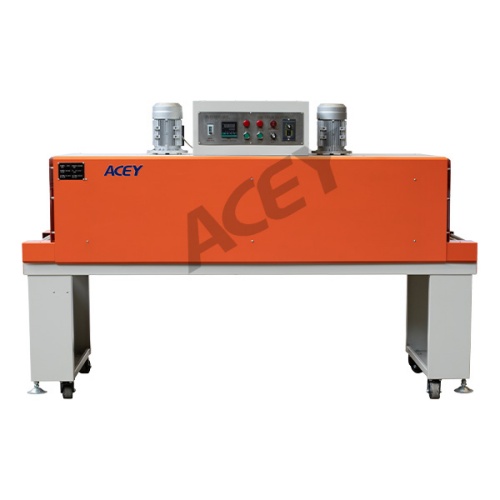
For heat-shrink packaging, the pack passes through a temperature-controlled shrink tunnel.
ACEY heat shrink machines are available with adjustable conveyor speed and temperature settings for different pack sizes and film materials.
Recommended Equipment: Automatic Heat Shrink Wrap Machine
Step 9 — Coding and Traceability
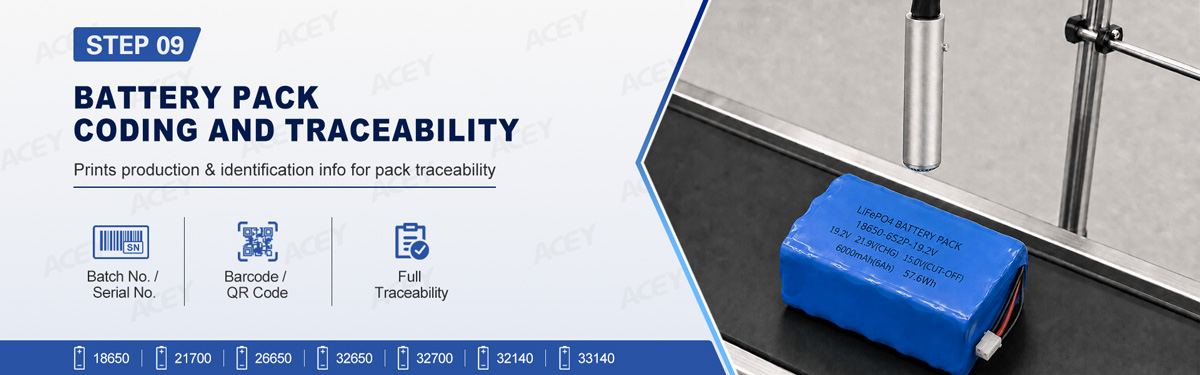
Pack identification is added before shipment or aging.
Printed information includes:
A handheld printer may be enough for small-batch production, while conveyor-based or continuous inkjet printers are more suitable for production lines.
If traceability is required, the printed code can be linked with earlier cell or pack test records.
Recommended Equipment: Battery Pack Coding Machine
Step 10 — Charge/Discharge Aging
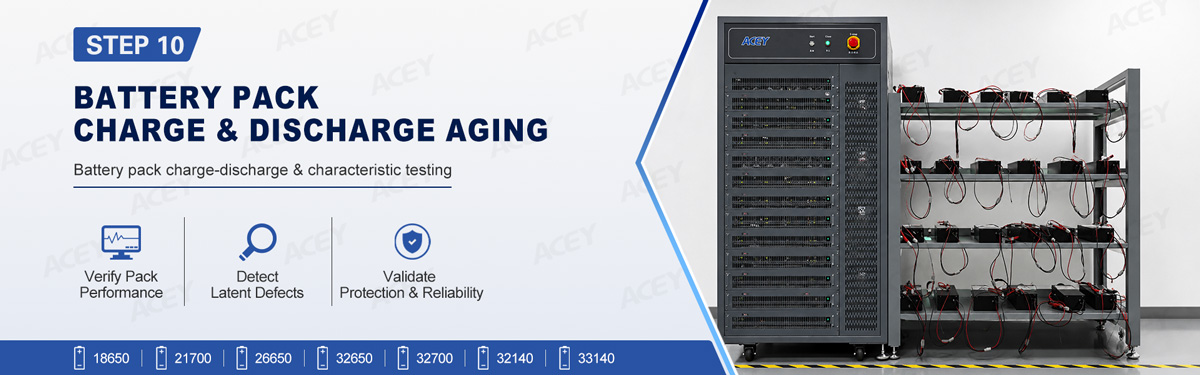
Aging is one of the final electrical verification steps.
The battery pack is charged and discharged according to a programmed test sequence. The system can record:
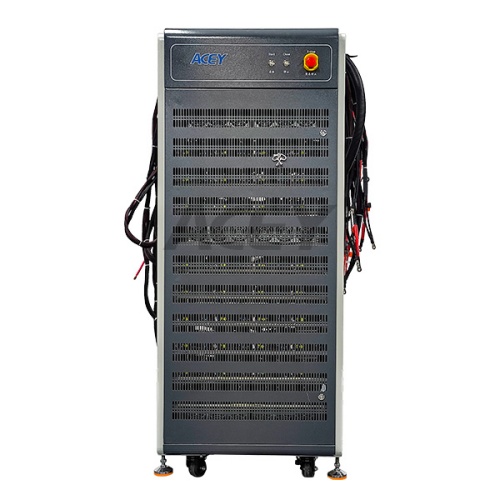
ACEY battery pack charge-discharge and aging systems cover a wide range of battery pack applications.
Available configurations include:
The selected tester must cover the pack’s maximum voltage and required charge/discharge current. Channel quantity is usually selected according to the planned production output and aging time.
For higher-power applications, energy-feedback systems can return part of the discharge energy to the electrical network instead of dissipating it only as heat.
Recommended Equipment: Battery Pack Aging Machine
Semi-Automatic or Fully Automatic?
The higher automation option is not always the better choice.
A semi-automatic production setup is more flexible when the manufacturer produces several battery pack models or changes fixtures frequently.
| Factor | Semi-Automatic Line | Fully Automatic Line |
| Production Volume | Small to medium | Medium to high |
| Investment | Lower | Higher |
| Changeover | More flexible | More dependent on tooling and line design |
| Labor | More manual operations | Lower labor requirement |
| Integration | Standalone or partially connected equipment | Integrated material flow |
| Traceability | Added where required | Easier to integrate across multiple processes |
Many cylindrical battery pack lines use a combination of both.
For example, cell sorting, CCD polarity inspection and automatic spot welding can be automated, while BMS installation, wiring or enclosure assembly remains manual.
This approach often gives better flexibility than trying to automate every process from the beginning.
How to Configure Cylindrical Battery Pack Assembly Equipment
The equipment should be selected from the actual battery pack design rather than only from the cell model.
Two 21700 battery packs may require completely different fixtures, welding machines and test systems if their series-parallel configuration, current requirement and mechanical structure are different.
Before equipment selection, it is useful to confirm the following information.
Cell Information
Battery Pack Design
Welding Information
BMS Information
Production Requirement
Testing Requirement
These details make it much easier to match each machine to the actual process and avoid buying equipment with either insufficient capacity or unnecessary specifications.
ACEY Cylindrical Battery Pack Assembly Solutions
ACEY supplies individual machines, semi-automatic production equipment and fully automatic assembly solutions for cylindrical lithium battery packs.
Equipment can be configured for cells including:
18650 · 21700 · 26650 · 32650 · 32700 · 32140 · 33140
Available processes cover:
For production-line projects, the configuration is developed around the customer’s battery pack, required output and test process rather than from a fixed machine list.
Planning a Cylindrical Battery Pack Project?
Please provide:
This information allows us to recommend the required machines, tooling, welding configuration and test system for the actual pack.
Discuss Your Battery Pack Assembly Project →
Frequently Asked Questions
*What machines are needed to make a cylindrical battery pack?
A typical production setup may include a cell grading machine, insulation paper sticking machine, OCV/IR sorter, CCD polarity tester, spot welder, BMS tester, battery comprehensive tester, packaging machine, coding machine and battery pack aging tester.
Small-batch production does not necessarily require all processes to be automated.
*What cylindrical cells can be used?
Common formats include 18650, 21700, 26650, 32650, 32700, 32140 and 33140.
Whether one machine can handle several cell sizes depends on its mechanical range and tooling. Fixtures, feeders and holders may need to be changed when switching cell formats.
What is the difference between capacity grading and OCV/IR sorting?
Capacity grading measures cell capacity through charge-discharge testing.
OCV/IR sorting measures open-circuit voltage and internal resistance and groups the cells according to preset ranges.
They are different steps and are often used together before battery pack assembly.
Why check cell polarity before welding?
A reversed cell can create the wrong series-parallel connection once the nickel strip is welded.
CCD inspection checks the complete cell arrangement before welding and identifies cells placed in the wrong direction.
What type of spot welder is used for cylindrical battery packs?
Resistance spot welding is commonly used for nickel and nickel-plated connecting strips.
ACEY provides 5000A, 8000A and 10000A welding power supply, including gantry, single-side automatic and double-side automatic configurations.
Los parámetros de la máquina y de soldadura deben seleccionarse en función del terminal de la celda, el material de la tira, el espesor de la tira y el patrón de soldadura.
¿Cuál es la diferencia entre bateador?¿Pruebas exhaustivas y pruebas de envejecimiento del paquete?
¿Puede una misma línea de producción fabricar diferentes tipos de baterías?
Sí, pero no sin un cambio.
Si cambia el diámetro de la celda, las dimensiones del paquete o el patrón de soldadura, también será necesario cambiar el soporte, el accesorio, el alimentador o el programa de soldadura.
Las líneas semiautomáticas ofrecen mayor flexibilidad a los clientes que fabrican varios modelos de baterías.
¿Qué información necesita ACEY antes de recomendar una línea de producción?
La información más útil es:
Con estos detalles, el equipo y las herramientas se pueden seleccionar en función del paquete de baterías específico, en lugar de utilizar una configuración de línea genérica.
703, 7F, Zhonghengji Building, No.223, Qishan North Road, Huli District, Xiamen, Fujian, China
Email : allen@xmacey.com
Tel : +8618950009155
Whatsapp : +8618950009155