XIAMEN ACEY NEW ENERGY TECHNOLOGY CO., LTD.

BMS Tester vs. Battery Pack Comprehensive Tester: Test Object, Series Count and Current Range
November 18 , 2026
A BMS tester checks the protection board before it goes into a pack; a pack comprehensive tester checks the finished pack at the end of the line. Between those two machines, the choice is made on the number of cells in series, the charge and discharge current and the test items required — not on whether the pack is built from cylindrical, prismatic or pouch cells. The same tester is used across cell formats. Starting from the test object and the electrical specification is the reliable way to build a testing equipment list.
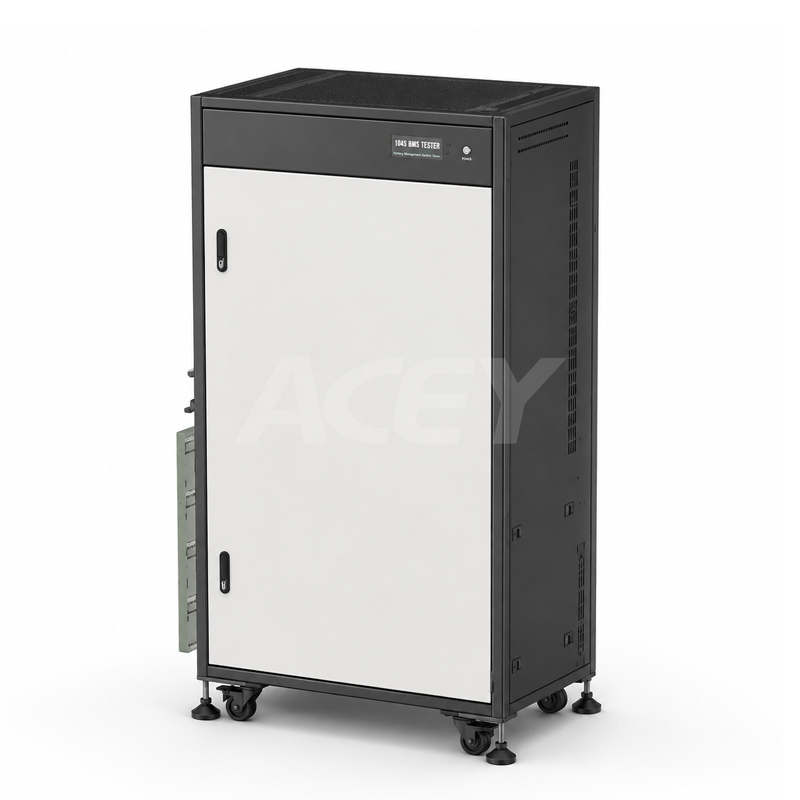
A BMS tester verifies the protection board before pack assembly. It checks overcharge, over-discharge, overcurrent and short-circuit protection, and confirms that the board will operate safely once it is installed. In a pack line the tester sits after cell joining and before the board goes into the pack.
A pack comprehensive tester, also called an integrated or end-of-line tester, measures a completed pack. It covers pack voltage, internal resistance, charge and discharge performance, and pack-level protection response in one test process, verifying the electrical performance and functional integrity of the finished pack. Checks on an assembled pack belong here, not to the BMS tester.
These are two different machines with two different test objects and two different positions in the workflow. A protection board tester and a finished-pack tester are not two names for the same equipment, and one does not replace the other.
The cell format changes the pack, not the test instrument. The same BMS testing equipment is used across cylindrical, prismatic and pouch pack builds, because what the tester connects to is a protection board with a given series count and current rating. A single protection board tester checks BMS boards for MCN, LiFePO4 and cobalt acid batteries, and a 1-104S model covers lithium-ion, LiFePO4 and lithium cobalt oxide boards together with hardware BMS boards and some software BMS boards.
Configuration follows four fields. None of them is the external shape of the cell.
| Selection field | What it sets on the tester |
|---|---|
| Cells in series | The series range the board can be tested at — models cover 1-24 Series, 1-32 Series and 1-104S. |
| Charge and discharge current | The current level the board must be exercised at, from 50A/120A up to 200A/300A and 500A/800A. |
| Required test items | Which protection functions and measurements are checked; active balancing, balancing current and communication protocol testing can be added. |
| Data and integration | Excel data export, log tracking, barcode start and MES connection where traceability is needed. |
A tester specified this way works on the protection board regardless of the cell format around it. What separates one model from the next is the series count and the current range, not the pack housing.
The core test functions are overcharge, over-discharge, overcurrent and short-circuit protection. Testing checks protection thresholds, recovery voltages, response delays, charge and discharge overcurrent thresholds, and short-circuit response times, with an accurate simulation of charging, discharging and protection conditions.
Depending on the model, additional measurements cover BMS current consumption, main circuit resistance and cell-balancing activation voltage. Active balancing and balancing current tests can be customized, and communication protocol testing is optional. Some models provide a laboratory mode that adjusts the voltage of a single section manually, for R&D testing, abnormal-condition simulation and detailed performance verification.
These functions target the protection board itself. A tester that simulates charge, discharge and protection conditions confirms the quality and reliability of the board and reduces the risk of battery failures and safety hazards before the board is fitted.
Accuracy and resolution figures shared by several models are listed once.
| Model | Values and functions |
|---|---|
| ACEY-BP24-200A300A, 1-24 Series | 200A charge and 300A discharge; input power 180 ~ 240V 50/60HZ, 5000W; charging and discharging voltage 5000mV ~ 160,000mV; current accuracy and voltage accuracy ±(0.1%FS+0.1%RD); current resolution 1mA; voltage resolution 1mV; cycle times 1 to 9999. Suitable for BMS of MCN, LiFeO4 and cobalt acid batteries. |
| ACEY-BP24-50A120A, 1-24 Series | 50A charge and 120A discharge; cycle times 1 to 9999; laboratory mode to adjust the voltage value of a section; continuous charging and discharging current output; log tracking of operation and abnormal records; test data saved in an Excel file; RS232 interface; MES system interface; active equalization and equalization current available as custom options |
| ACEY-BP104-300A300A, 1-104S | 300A overcharge protection testing and 300A over-discharge protection testing; compatible with 1-104S battery protection boards; lithium-ion, LiFePO4 and lithium cobalt oxide protection boards; hardware BMS boards and some software BMS boards; cycle times from 1 to 9999; Excel data export; barcode start and MES connection. Laboratory mode allows manual adjustment of any single cell voltage, for R&D testing, abnormal-condition simulation and detailed performance verification. |
| ACEY-BP32-500A800A, 1-32 Series | 500A continuous charging and 800A discharge; input power 180 ~ 240V 50/60HZ, 5000W; charging and discharging voltage 5000mV ~ 160,000mV; current accuracy and voltage accuracy ±(0.1%FS+0.1%RD); current resolution 1mA; voltage resolution 1mV. Tests cover overcharge and overdischarge protection and recovery, overcurrent, internal resistance, self-consumption, short-circuit protection and protection delay times. |
| ACEY-BMS-2, 1-24 / 1-32 Series | Protection plate BMS tester with PC software for the battery BMS board tester |
The current figures are charge and discharge ratings on the protection board, not pack capacity. The 1-104S tester runs 300A overcharge and 300A over-discharge protection tests with fast testing, high accuracy and stable data acquisition, and its laboratory mode supports single-cell voltage adjustment.
The same tester families handle several chemistries. A protection board tester can check the BMS of MCN, LiFeO4 and cobalt acid batteries; a 1-104S model covers lithium-ion, LiFePO4 and lithium cobalt oxide boards, along with hardware BMS boards and some software BMS boards. The 1-32 Series model with 500A charging and 800A discharge is aimed at EV, e-forklift and large-scale energy storage BMS manufacturing.
This is why cell format is the wrong starting point. A cylindrical, prismatic or pouch pack can use the same protection board tester if the series count and current are within the instrument's range. Naming a format does not tell you which model to buy; the series count and the current do.
Battery pack integrated testers combine pack voltage, internal resistance, charge and discharge performance, and BMS protection functions in a single test process. They verify the electrical performance and functional integrity of a completed pack, and are used in production and R&D on power battery, energy storage and power tool assembly lines.
Pack comprehensive testers measure open-circuit voltage, AC internal resistance, charge and discharge voltage and current, overcurrent protection and short-circuit response time. Options include cell voltage monitoring, BMS communication checks, insulation resistance and dielectric withstand tests. These tests support production quality checks and end-of-line inspection.
Finished-pack testers are defined by their voltage, resistance and current ranges.
| Comprehensive tester model | Ranges and functions |
|---|---|
| ACEY-BIT200-150A400A | No-load voltage and short-circuit protection voltage range 0-200V; ACIR1000hz internal resistance range 0-4000mΩ; charging overcurrent protection current range 0-150A; continuous charging current range 0-150A; discharge overcurrent protection current and delay time range 0-400A; continuous discharge current range 0-300A; short-circuit protection time ≤1000μ, maximum short-circuit current about 5000A; single cell voltage monitoring |
| ACEY-BIT100-30A120A | No-load voltage and short-circuit protection voltage range 0-100V; ACIR1000hz internal resistance range 0-4000mΩ; charging overcurrent protection current range 0-30A; continuous charging current range 0-30A; discharge overcurrent protection current and delay time range 0-120A; overcurrent test mode available as step test or quick test |
| ACEY-BIT60-30A300A | Suits lithium-ion battery packs with CH+P+CH-P- ports; repeated charge-discharge cycles simulate different usage scenarios and evaluate pack performance |
These voltage and resistance ranges apply to a completed pack. The ACEY-BIT200-150A400A works as a high-precision electronic load and a comprehensive battery analyzer, for power battery series with CH+, P+, CH- and P- terminals. The ACEY-BIT100-30A120A is a fast, accurate tester for finished lithium-ion packs with the same terminal layout.
Configuration follows pack voltage, charge and discharge current requirements, terminal layout and the required test sequence. The optional measurements listed above are added where the test plan calls for them.
Where programmed charge-discharge cycling and aging tests are needed, those belong to battery aging machines rather than to the comprehensive tester. Keeping the two separate avoids assigning a long-duration cycling job to an end-of-line instrument.
Three further BMS-related product groups sit beside the testers. They are parts installed in a pack, not machines that test one.
| Product group | Description |
|---|---|
| Hardware BMS | Protection parameters are fixed by the component parameters; suitable for lithium ion, lithium polymer and lithium iron phosphate batteries, with strong load capacity and continuous discharge current up to 200A. |
| Smart BMS | Options for lithium and LiFePO4 packs, with monitoring, balancing and communication features matched to the battery configuration. |
| Battery Balancers / Equalizers | When cell voltages are inconsistent, the active equalization module transfers energy between cells to reach voltage equalization and power sharing. Widely used in electric vehicles, energy storage systems and other lithium battery pack applications. |
Cell-balancing activation voltage and balancing current appear as measurements on the tester side, which makes these parts the object of a test rather than the test equipment itself. Listing a Smart BMS or a Battery Balancer as test equipment mixes a component group with a test group.
Protection board testing and finished-pack testing are two separate entries in a pack line. The order below shows where each one falls.
| Line or equipment group | Process sequence |
|---|---|
| 18650 21700 26650 32700 cylindrical pack line: assembly process | Cell capacity grading → Insulation paper pasting → Cell voltage & IR sorting → CCD testing → Battery pack spot welding → BMS testing → Battery pack comprehensive testing → Shrink film packaging → Inkjet code printing → Battery pack aging testing. |
| Full automatic ESS prismatic pack line: process flow | Cell sorting process, Stacking and extrusion process, Polarity testing process, Laser cleaning process, Automatic laser welding process, EOL testing process, Pack packaging process, BMS testing process, Comprehensive test process and Aging test process. |
| Cylindrical Battery Pack Assembly Equipment | Spot welders, BMS testers, battery comprehensive testers, heat shrink machines, coding machines and battery aging machines, in that order among the main equipment. |
On the cylindrical line, BMS testing follows battery pack spot welding and comes before battery pack comprehensive testing. On the full automatic prismatic line, BMS testing comes after pack packaging and before the comprehensive test process. Both sequences keep board testing and pack testing as two separate steps — one on the protection board, one on the finished pack.
A BMS tester checks the protection board before pack assembly; a comprehensive tester checks the finished pack at end of line. An integrated tester checks pack voltage, internal resistance, charge and discharge performance and BMS protection functions in one process. Programmed charge-discharge cycling and aging tests belong to battery aging machines.
No. The cell format changes the pack, not the tester. The same protection board tester is used across formats, and a single model checks BMS boards for several chemistries — MCN, LiFePO4 and cobalt acid, or lithium-ion, LiFePO4 and lithium cobalt oxide. Selection follows the cells in series, the charge and discharge current, and the test items required.
Models cover ACEY-BP24-200A300A (1-24 Series, 200A charge and 300A discharge), ACEY-BP24-50A120A (1-24 Series, 50A charge and 120A discharge), ACEY-BP104-300A300A (1-104S, 300A overcharge and 300A over-discharge protection testing), ACEY-BP32-500A800A (1-32 Series, 500A continuous charging and 800A discharge), and ACEY-BMS-2 (1-24 / 1-32 Series protection plate tester with PC software).
Etiquetas :
Rm703, No.223, Qishan North Road, Huli District, Xiamen, Fujian, China
Email : allen@xmacey.com
Tel : +8618950009155
Whatsapp : +8618950009155